• Skip to primary navigation
  • Skip to main content
  • Skip to primary sidebar

Ministry Management System

Enabling growth through leveraging and scaling up the talent and expertise of our leaders ...

  • HOME
  • Management System Administration
  • Leadership
  • Human Resources
  • Execution
  • Measurement, Analysis, and Improvement
  • Administration
  • Arts
  • Connections
    • Pastoral Care
  • Groups
  • Operations
    • Finance
  • Outreach
  • Preschool
  • Student Ministries
  • Teaching
  • Children’s Ministry

Kevin Stone

Strategic Planning Operating Procedure

December 29, 2024 By Kevin Stone

Purpose

The purpose of this operating procedure is to establish, document, and communicate the process for strategic planning at YOUR CHURCH.

Scope

The strategic planning process is used by senior staff to evaluate the organization’s performance, in terms of meeting stakeholder needs, and to develop a plan to better meet those needs during the coming planning period. The process begins with an annual strategic planning session and ends with the distribution and periodic update of a strategic plan document as well as a set of assumptions and other input for the financial planning process.

Responsibility

As with all procedures and other documentation contained in the YOUR CHURCH Management System, it is the responsibility of all ministry area leaders to ensure the details of this process are known and followed by all YOUR CHURCH paid staff and ministry area volunteers. The primary responsibility for this process rests with the Executive Pastor.

Procedure

(1) Prepare and Distribute Planning Session Pre-Work

(1.1) To begin the annual strategic planning process, the Executive Pastor schedules the time with the Ministry Staff. Time can be spent all at once in a multi-day offsite meeting or a day per week can be devoted for several weeks.

(1.2) The planning session schedule should allow completion of this process and the financial planning process in time to gain leadership team approval by or before the 1st week in December.

(1.3) The Ministry Staff is provided with an updated Percept Ministry Area Profile, previous month KPMs, other survey results, etc. along with an agenda for the planning session(s) prior to the first meeting.

(1.4) Each Ministry Staff member should meet with their team (staff and/or volunteer) in preparation for the planning session. These meetings should be focused on gaining input and insight from the team as to the results from the previous year and what needs to happen in that ministry in the coming year.

(1.5) The results from these “pre-planning meetings” should be documented using a Strategic Planning Process Questionnaire and should be brought to the first planning meeting.

(2) Review/Update Stakeholder Needs

(2.1) The first step in developing the Strategic Plan for the coming year is an evaluation of the stakeholders and how well YOUR CHURCH has met their needs over the previous year.

(2.2) The stakeholder needs evaluation is accomplished through a thorough review of the demographics to improve the team’s understanding of the target group and their needs.

(2.3) The outcome of the stakeholder evaluation is documented via a target group profile document. The document is updated each year as needed to keep it current.

(2.4) Determining how well YOUR CHURCH has met the stakeholder needs is accomplished through a review of the “results” (KPMs) as well as other information the Ministry Staff may have (discussions with newcomers, experiences with volunteers, informal feedback, surveys, etc.).

(3) Review/Update Strategy

(3.1) The next step in the planning process is a review of the documented strategy.

(3.2) Equipped with a renewed understanding of stakeholder needs, the Ministry Staff reviews all parts of the documented strategy to ensure its implementation will completely and effectively meet the needs of the stakeholders.

(3.3) If necessary, the strategy is revised to correct any concerns that its implementation will not completely meet stakeholder needs.

(3.4) Any changes to the strategy are recorded and included in the final strategic plan document.

(4) Develop Key Objectives

(4.1) The next step in the planning process is the creation of a master set of key objectives.

(4.2) The key objectives state what the Ministry Staff determines are those specific actions needed, for the given planning period, to improve existing systems, processes, and methods or to create new systems, processes, and methods.

(4.3) Key objectives are brainstormed during the planning session. Each key objective should be connected to a specific measure or measures and be clearly an action deemed necessary to improve the church’s implementation of the strategy.

(4.4) Each key objective is listed and an “objective leader” is assigned that is responsible for ensuring the objective is completed.

(4.5) The objective leader, working with the rest of the Ministry Staff, commits to a due date for the objective, which is also documented.

(4.6) The list of key objectives, along with leaders and due dates for each, is recorded in the final strategic plan document.

(5) Conduct Organizational Review

(5.1) Once the plan is documented (at least in draft form), the process of determining what resources will be necessary to ensure its successful completion is initiated.

(5.2) The first resource area to consider is the existing staff and volunteers. The organizational review is a formal review and discussion of how the church is currently organized and how, if necessary, the organization should change over the coming planning period.

(5.3) In addition to the organizational structure, the Ministry Staff discusses each member of the staff as well as key volunteer leaders, determining where weaknesses exist and how best to address these weaknesses.

(5.4) A formal “faces to watch” list is developed and documented as a vehicle for discussing up and coming leadership talent in the church, being sure to identify staff positions or areas of service that could be filled with up and coming leaders.

(5.5) An initial list of “new hires” is also developed and documented as part of the organizational review. The financial resources needed to add the people or positions on the list are determined as part of the financial planning process. Adjustments in the list are made if necessary which more often than not impacts the key objectives previously identified.

(5.6) The outcomes of the organizational review process include revised organizational charts as well as listings of both “faces to watch” and agreed upon new hires.

(6) Develop Financial Planning Assumptions

(6.1) From the draft of the Strategic Plan a set of assumptions is developed that will drive the financial planning process.

(6.2) First, the plan drives the creation of an income model that helps the Ministry Staff to project the income line of the budget.

(6.3) Major events, conferences, etc. are listed in the assumptions along with timing and rough cost estimates.

(6.4) The outcome of the organizational review in terms of planned staff additions is used to determine the salary and benefits budgets.

(6.5) The cost to implement other key objectives is also included in the financial planning assumptions.

(7) Finalize and Distribute Strategic Plan

(7.1) After the Strategic Plan has been adjusted as a result of the financial planning process and other considerations, a final draft is distributed for the Ministry Staff’s review.

(7.2) Following the final review, the master copy of the strategic plan is published in the YOUR CHURCH Management System. YOUR CHURCH staff is notified and encouraged to review and get familiar with the completed plan.

(7.3) The Strategic Plan is reviewed by the Ministry Staff and adjusted as needed on a monthly basis.

Related Documents:

Key Performance Measures (KPMs)
Strategic Plan
Strategic Planning Process Questionnaire
Percept Ministry Area Profile
Percept Ministry Area Profile Info Maps
Filed Under: Operating Procedures

Management System Manual

December 29, 2024 By Kevin Stone

Purpose

The purpose of the Management System Manual is to define, describe, and outline the backbone of YOUR CHURCH’s continued efforts to accomplish its mission.

Scope

This Management System Manual is the highest level document contained in the Management System. All of the contents of the Management System are organized under the 5 Elements described herein.

Responsibility

Along with everything else contained in the Management System, all ministry area leaders must ensure the details of this manual are known and understood by all YOUR CHURCH paid staff and ministry area volunteers. The primary responsibility for this manual rests with the Executive Pastor.

Management System Description

The Management System is the backbone of YOUR CHURCH’s continued development of a strong, capable infrastructure. It enables growth through leveraging and scaling up the talent and expertise of our leaders.

To define the Management System, we must begin with the term Quality. What do we mean when we say something is high quality?  Or, what do we mean when we say something is excellent?

The International Standards Organization (ISO) defines Quality as “The totality of features and characteristics of a product or service that bear on its ability to satisfy a defined requirement.”  In other words, quality is fitness for purpose.

How does this apply to YOUR CHURCH?  What is fitness for purpose? Simply put, Quality is how well we accomplish the purpose. And, of course, our purpose is to honor God by following his teachings.  Specifically to be a community that reaches the lost and helps them become “disciples of Jesus.”

So, Quality means getting the job done well.  And, getting the job done well is a combination of …

  • Knowing the Stakeholder Needs
  • Equipping YOUR CHURCH to Meet Those Needs
  • Excellent Implementation
  • Reliable Inputs
  • Clear Instructions
  • Efficient, Effective Execution
  • Feedback and Continuous Improvement

The main ingredient of the Management System is people. As leaders, we must find staff and volunteers, train and develop them, communicate well with them, and implement systems that help them succeed. The Management System is the framework for getting this done.

The Management System contains the methods we use to analyze stakeholder needs, define processes that meet those needs, and manage these processes to ensure that results are predictable and repeatable.

The Management System also provides the framework for continuous improvement, increasing the likelihood of achieving stakeholder satisfaction. It gives the stakeholders confidence that YOUR CHURCH has the capability to deliver consistently.

Benefits of the Management System

There are many reasons YOUR CHURCH has implemented a Management System.

Consistency – The first is that it brings consistency to routine activities and helps to ensure best practices.  What does that mean? One of the biggest challenges in any successful organization is effectively identifying, recruiting, training, and deploying leaders. The senior leader’s ability to constantly communicate and give direction is limited. Even the best leaders can only do so much. Keeping up with an increasing demand for new staff and volunteers requires us to develop and implement systems. These systems, collectively, form the Management System.

Training – The Management System is a training aid that enables quick and efficient training of staff and volunteers. Best practices are established, documented, and made available to everyone needing to know.

Communication – The Management System formalizes our communication infrastructure. Simply put, it provides a vehicle for organizing and disseminating information. Once set up, a “one-stop shopping” simplicity is in place when information is needed to get something done. From how I spend money to how we assess an individual’s spiritual gifts, methods are established and made available, enabling new people to come up to speed quickly.

Improvement – The Management System is a means to manage and facilitate change and improvement. One of the biggest obstacles to flexibility and change for the better is the lack of formal, established methods. It’s very difficult to “rally the troops” around a change or quick tweak to something when nothing is “formally” in place.

Management System Organization

The Management System is organized under 5 different sections or elements, with a manual at the top of the hierarchy.

The Management System Manual defines the “minimum requirements” under each element. For example, under “Management System Administration,” the manual explains that systems are in place to ensure the proper control of data, documents, and records. It refers to a set of procedures that the church follows to ensure the consistent control of data, documents, and records. The Management System Manual also functions as a guide to the system’s organization and hierarchy, helping us navigate and easily find what we need.

The elements of the Management System are listed below, along with a listing of the areas under each element within which YOUR CHURCH has defined minimum requirements:

Management System Administration

  • Control of Data, Documents, and Records
  • Policy and Procedure Review and Approval
  • Access to Information
  • Document and Data Distribution
  • Version Control
  • Record Retention

Leadership Responsibility

  • Church Governance
  • Organizational Structure
  • Responsibility and Authority
  • Strategic Planning
  • Management System Review
  • Environmental Responsibility

Human Resources

  • Recruiting
  • Position Descriptions
  • Training and Development
  • Performance Review
  • Health and Safety Requirements

Execution

  • Ministry Area Operations
  • Finance
  • Purchasing and Supplier Development
  • Office Operations
  • Information Technology
  • Facilities Management
  • Safety and Security
  • Project Management

Measurement, Analysis, and Improvement

  • Measurement of Results
  • Management System Assessment
  • Continuous Improvement
  • Corrective and Preventive Action

Filed Under: Management System Administration, Management System Manual

The Performance Cycle

December 29, 2024 By Kevin Stone

Introduction

Developing infrastructure is the single most significant role of the leader of a growing organization.  But with all the demands on the leader, how does it have a chance of actually happening?  The Performance Cycle is a leadership model that provides the leader with the framework from which to develop a strong, stakeholder focused, infrastructure.  And, it’s simple enough to be easily understood by everyone.  It can also be used at any level in the organization, regardless of the challenge.

It’s all about scalability!  How can an organization leverage its knowledge and leadership?  There are only so many leadership people to go around and good leaders are extremely difficult to find.  So … building a world-class organization depends on the leader’s ability to develop good systems, processes, and methods and to make them known (easy to access, learn about, use, and change as needed) to the entire organization.  Unfortunately, this is a foreign concept to many leaders!

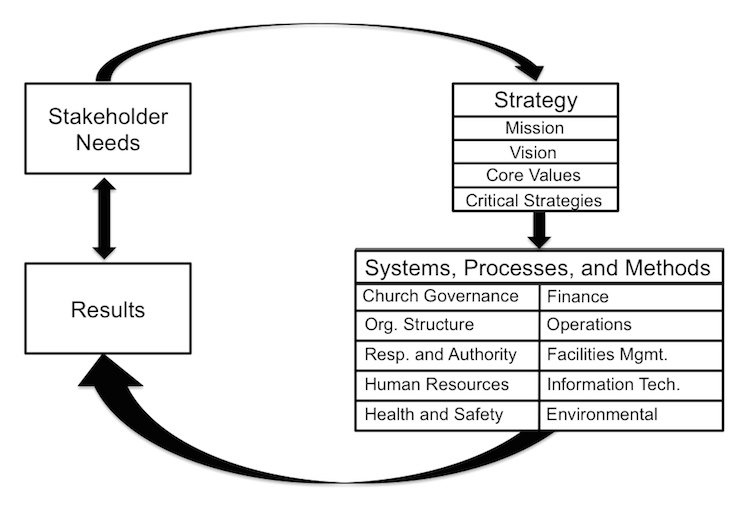
In short, The Performance Cycle is a model (below) for developing organizational infrastructure.Alignment is the goal. Is the Strategy aligned with the Stakeholder Needs? Are the Systems, Processes, and Methods aligned with the Strategy?

Stakeholder Needs

How does it work? It starts with working to understand Stakeholder Needs. The question is “Who are the stakeholders and what are their needs?” You might be wondering at this point what is meant by the term stakeholder. A stakeholder is the group of people with a stake (interest, benefit, concern, etc.) in the organization or endeavor.  In the church the obvious most important stakeholder is Jesus. In addition to Jesus, the community at large, the target group, attendees, volunteers, members, elders, and church staff are also stakeholders. Prayer, Bible study, demographic studies, surveys, and staff team experiences are all important tools in developing a thorough understanding of the needs of the stakeholders.

Strategy

Once an understanding of Stakeholder Needs is achieved, it’s time to develop a Strategy to meet the needs. What is the church going to do to meet the needs of the stakeholders? It’s pretty simple. Jesus told us that we must Go, Baptize, and Teach (Matt 28:18-20). Another example would be determining and understanding the “felt needs” of the target group and designing “experiences” that are designed to address those needs.

The Strategy is made up of a mission, vision, and a set of critical strategies the church will implement/accomplish to satisfy the stakeholders.

Systems, Processes, and Methods

Now that a Strategy has been developed and documented, leadership must create and implement systems, processes, and methods that accomplish the Strategy. Systems, processes, and methods are most often implemented via a Management System or some similar structured approach. The Management System is the backbone of the Performance Cycle. It’s the vehicle for ensuring that systems, processes, and methods are consistent, compatible with one another, and known by everyone in the church … especially new people. The Management System is a topic unto itself.

Results

How is leadership going to know how well the church is meeting its Stakeholder Needs? The answer is simple … through measuring results. It’s critical that the leaders in the church create measures that provide “at a glance” visibility of results (performance). If you’re not measuring it, you probably aren’t managing it. A great method for measuring results is to establish Key Performance Measures (KPMs) that are updated and reviewed by everyone on the team on a regular basis. For example, a graph showing “average weekly attendance” over time would be a good KPM.

Corrective Action (Diagnosis)

What happens when a measure shows that something isn’t working … isn’t meeting a Stakeholder Need? It’s pretty simple. Leaders must go into diagnosis mode, reversing the arrows on the Performance Cycle.

The first place to go is the Systems, Processes, and Methods box. Is there something that the church is doing (or not doing) that is causing a measure to go in the wrong direction? If the problem can’t be found in that box, the team must continue up to the Strategy box. Does the Strategy truly address the Stakeholder Need? What should be changed or tweaked? And if that’s not it, does the church really understand its stakeholders and their needs?

Filed Under: Leadership Responsibility, Position Papers

Baptism Position Paper

December 28, 2024 By Kevin Stone

Introduction

Over the years one of the most discussed aspects of YOUR CHURCH’s beliefs is the role of baptism in the process of becoming a Christian. To help give you a better understanding of our position we have provided an adapted chapter from Dr. Jack Cottrell’s book The Faith Once For All for people in our congregation. This chapter does an excellent job of succinctly expressing what the Bible teaches regarding this important subject in an in-depth and technical manner. While we always stress that scripture alone dictates what we believe and practice, it sometimes helps having a knowledgeable teacher come alongside us and guide us. Our hope is that as you read Dr. Cottrell’s words, you will find answers to your questions and be encouraged by his counsel.

A comprehensive explanation of baptism must answer three main questions. First, what is the purpose of baptism? Second, who should be baptized? And third, how should baptism be performed? These are the questions of the meaning, the subjects, and the mode of baptism. This chapter will attempt to answer them in this order.

The Meaning of Baptism

Most important is the meaning of baptism, since the answer to this question helps us to determine the answers to the other two. It is important also because it has been a source of serious controversy ever since the Reformation of the sixteenth century. The heart of the issue is whether baptism has a crucial role in the reception of salvation. More specifically, is baptism something a sinner does in order to receive salvation and become a Christian, or is it simply a good work (an act of obedience) done for some other purpose by someone who is already a Christian?

The Bible is very clear about this. In every NT passage that says anything at all about the meaning of baptism, the only purpose with which it is connected is the salvation of sinners. The various aspects of salvation are described as being bestowed upon the believing, repentant sinner in the act of baptism. This is the consistent and exclusive NT witness; no other purpose for baptism is mentioned or even hinted at. This is why we may speak of baptism (along with faith, repentance and confession) as a condition for salvation. 

Baptism and the Double Cure

God’s work of salvation through Jesus Christ may be summarized as having a “double cure.” Sin creates two problems for the sinner, both of which are addressed by God’s saving grace. First, sin brings the legal problem of guilt, resulting in the sinner’s liability to the penalty of eternity in hell. Also, sin makes a person sinful. That is, it affects the person’s very nature; it makes him depraved or spiritually sick. This corrupts the sinner’s inner being, sapping his spiritual strength and trapping him in the grip of sin.

God’s gracious salvation addresses both sides of this predicament. On the one hand, God’s solution to guilt is justification, also called the forgiveness or remission of sins. This is accomplished only by the redeeming blood of Christ by which he paid the penalty deserved by those who have broken God’s divine law. When the blood of Christ is applied to the penitent sinner, his guilt and condemnation are washed completely away. On the other hand, God’s cure for the sinner’s depraved nature is the gift of the Holy Spirit, whose life-giving presence renews and regenerates the sin-sick heart and breaks the death-grip of sin upon the soul. Biblical terms for this work of the Holy Spirit include new birth, new creation, being made alive, resurrection, regeneration, renewal, and circumcision without hands. Following this initial act of spiritual resurrection, the Holy Spirit dwells within the saved person as a source of spiritual strength and continuing sanctification.

In summary, in the double cure of salvation God takes away the sinner’s guilt through the blood of Christ and renews his heart through the life-giving power of the Holy Spirit. Only divine power can accomplish these things. The question being addressed here, though, is when does God choose to work these powerful works in the heart of the sinner?

Almost everyone would agree that the Bible relates salvation to baptism in some sense. All would acknowledge, for example, that baptism and salvation are connected at least symbolically. That is, the act of baptism is a physical symbol of the reality of spiritual salvation. It is “an outward sign of an inward grace;” the application of water to the body depicts the cleansing of the soul.

Some would go further and discern a psychological connection between baptism and salvation. They see the act of baptism as affecting the mental state of the person being baptized, as confirming or sealing upon his heart a deeper assurance of the salvation that God has already bestowed upon him. The baptized person can say to himself, “Just as surely as I am experiencing the baptismal water upon my body, I can be sure that God has applied his grace to my soul.”

Some have gone to the extreme of affirming a causal connection between baptism and salvation. They have attributed to the baptismal water or to the baptismal act the power to cleanse the soul from sin, or at least the power to convey that divine cleansing to the soul. Thus anyone who submits to the physical act of baptism will surely be saved, even in the absence of a proper knowledge of Christ and a positive faith in him. This is the doctrine of “baptismal regeneration,” and is usually held in connection with certain forms of infant baptism.

How shall we evaluate these views in the light of Scripture? Actually, none of them adequately expresses the NT teaching about the relation between baptism and salvation. The causal view described in the previous paragraph must be rejected altogether. There is no basis for ascribing any saving power to the baptismal water or to the act of baptism itself. God’s power and God’s action alone can save; the sinner is saved when God applies the blood of Christ to his heart and gives him the gift of the Holy Spirit.

Also, the symbolical and psychological views must be rejected, not because they are off the mark but because in themselves they do not go far enough. That is they do not give us the whole picture of the relation between baptism and salvation. It is true that water baptism symbolizes the reality of inward salvation, and that it strengthens faith in Christ and increases assurance of salvation. The problem is that those who emphasize these points often limit the meaning of baptism to these effects alone while denying that baptism is also the specific time when God bestows his gifts of salvation. They claim that as a rule a person is already saved before his is baptized. Baptism is a subsequent outward sign of a previously given inward grace, they say; thus it only strengthens one’s faith in a salvation already possessed. Such a limited view, however, is much too weak. It does not do justice to the NT teaching about what really happens during baptism.

In summary, we reject any causal relation between baptism and salvation. Also, we agree that baptism is symbolically and psychologically related to salvation, even though this is never actually stated in Scripture and is only inferred from what is taught therein. Most important, we affirm that the clear and specific teaching of the NT is that baptism is the time during which God graciously bestows upon the sinner the double cure of salvation. As such it is a divinely appointed condition for salvation during this New Covenant era.

Our purpose now is to set for the biblical evidence for this temporal relation between baptism and salvation. First, we will look at the passages which connect both aspects of the double cure with baptism, beginning with Acts 2:38; “Peter said to them, ‘Repent, and each of you be baptized in the name of Jesus Christ for the forgiveness of your sins and you will receive the gift of the Holy Spirit.’” This is Peter’s response to an audience of Jews whose rejection of their Messiah had put them into a lost state and who thus needed salvation. Their question to Peter (v. 37) was, “What shall we do?” That is, what shall we do to be saved? Peter names two things they must do: repent and be baptized. He also names two things they would receive as a result: forgiveness of sins, and the gift of the Holy Spirit – the double cure.

This verse specifically says that baptism is “for the forgiveness of sins.” Forgiveness (or remission) is equivalent to justification; it is the cancellation of all guilt by the power of the blood of Christ. This is the first part of the double cure. A key word in this statement is the word “for,” which translates the Greek preposition eis. Physically this term represents motion toward something; conceptually it signifies purpose or intention or result. In other words, Peter says to be baptized for the purpose of bringing about the forgiveness of sins. It is used in exactly the same way in Matthew 26:28, where Jesus spoke of his blood as being “poured out for many for [eis] forgiveness of sins,” i.e., for the purpose of bringing about the forgiveness of sins. Early editions of the NIV translated the sense of Acts 2:38 quite accurately: “Repent and be baptized…so that your sins may be forgiven.”

This verse also says that those who are baptized “will receive the gift of the Holy Spirit.” This refers to the indwelling presence of the Spirit as promised by Jesus in John 7:37-39; the specific immediate result of this indwelling is the new birth promised in John 3:3-5. The Spirit’s presence raises the spiritually dead sinner to a state of spiritual life, which is the second aspect of the double cure. This gift of the indwelling Spirit is specifically stated to be a consequence or result of baptism.

Thus Acts 2:38 makes the meaning of baptism clear. It is the time God has appointed for removing the sinner’s guilt and for bestowing upon him the regenerating presence of the Holy Spirit.

Another passage that expressly states that baptism is the time when God works the double cure is Colossians 2:12. It speaks of being “buried with Him in baptism, in which you were also raised up with Him through faith in the working of God, who raised Him from the dead.” Here two things are said to happen in baptism. First, we are “buried with Him,” i.e., with Christ. According to Romans 6:3-4 this means we are buried into the death of Christ. To be buried with Christ into his death means to receive all the saving benefits of his atoning death; it means to come into contact with his justifying blood and thus to receive the forgiveness of sins.

The second thing that happens in baptism is that we are “raised up with Him.” This refers to the initial act of the indwelling Holy Spirit. As soon as God gives us his Spirit (as promised in Acts 2:38), the Spirit infuses new life into our dead souls. Our spirits are raised from the dead by the same life-giving Spirit that raised Jesus’ body from the tomb (Romans 8:10-11; see Colossians 2:13).

Colossians 2:12 is important because it clearly and expressly says that these things happen “in baptism.” This does not mean before baptism, nor does it mean after baptism. It means exactly what it says: in baptism, in the act of baptism, at the time of baptism. We could not ask God to be more specific than this. In baptism God works the twofold work of salvation upon our hearts. This same relation between baptism and salvation is specified in Romans 6:3-5. In the baptismal act we are united with the death and resurrection of Christ, the result being justification and regeneration (see Cottrell, Romans, I:383-390).

Other NT passages relate baptism to the two aspects of the double cure individually. For example, Acts 22:16 connects it with the washing away of sins, which is equivalent to forgiveness. Thus when Ananias said to Saul, “Get up and be baptized, and wash away your sins, calling on His name,” he was saying exactly what Peter said in Acts 2:38: “Be baptized, for the purpose of bringing about the forgiveness of your sins.” The fact that baptism is the time of salvation is seen in the addition of the phrase, “calling on His name.” According to Joel 2:32 and Acts 2:21, the purpose of calling His name is to be saved.

Passages which individually related baptism to the second part of the double cure are John 3:5 and Titus 3:5. In John 3:5 Jesus says,” Unless one is born of water and the Spirit he cannot enter into the kingdom of God.” This is a reference to being “born again” (John 3:3), which is the same as the spiritual resurrection that Colossians 2:12 says takes place in baptism. That this new birth is somehow the result of both water and the Spirit brings to mind Acts 2:38, which connects water baptism with the gift of the Spirit. For this and other reasons we may rightly conclude that Jesus’ reference to water in John 3:5 speaks of baptism and makes it a condition for being born again.

Titus 3:5 in a similar way refers to baptism (“the washing”) as the time when the Holy Spirit regenerates and renews us. It says that God “saved us…by the washing of regeneration and renewing,” which are accomplished in that moment “by the Holy Spirit.”

The passages discussed above clearly set forth the meaning of baptism as the time when God bestows salvation’s double cure. Other NT passages related baptism to salvation in the same way, only in more general terms. For example, Matthew 28:18-20 says we are baptized into union with the Trinity; Galatians 3:27 says we are baptized into union with Christ; and 1 Corinthians 12:13 says we are baptized into the body of Christ. Two other verses state simply that the result of baptism is salvation: “He who has believed and has been baptized shall be saved” (Mark 16:16); and, “Baptism now saves you” (1 Peter 3:21).

Why Baptism Now Saves

Many do not understand why God would add a new condition for salvation not required in OT times. If faith in God’s gracious promises and a repentant heart were sufficient for salvation then, why not now? In reply we can identify at least two good reasons why God has connected salvation with baptism.

First, this new condition has been added because the salvation process under the New Covenant includes new elements not present under the Old Covenant. Baptism brings these new elements into focus and assures that the sinner is coming to God in full cognizance of them and not in terms of a framework that is obsolete and no longer adequate.

What are these new elements that raise New Covenant salvation to a higher level? First, there is a more complete revelation of the nature of God and thus an advanced understanding of the very object of our faith. We now know unequivocally that God’s nature is triune, i.e., that the Lord God of the OT is a Trinity of Father, Son, and Holy Spirit. Baptism was established to ensure that this new understanding of God would not be lost. This is why Jesus commanded that baptism be “in the name of the Father and The Son and the Holy Spirit” (Matthew 28:19).

Another new element in New Covenant salvation is the historical reality and the living presence of the Redeemer himself, Jesus of Nazareth. The fact that Jesus is the incarnation of God the Son gives concrete reality to the doctrine of the Trinity. His death on the cross and his resurrection from the dead – prophesied in the OT but for all practical purposes unknown in that era – are the literal source of our salvation. Baptism was established to ensure that we would never separate our salvation from the divine Redeemer Jesus nor from his saving death and resurrection. Thus baptism is not just in the name of “the Son” (Matthew 28:19) but “in the name of Jesus Christ” (Acts 2:38), who we must never forget is God the Son. Also, baptism is intended to draw our attention unmistakably to his death and resurrection as the works that bring us salvation (Romans 6:3-11; Colossians 2:12).

Still another new element is the specific saving work of the third person of the Trinity, the Holy Spirit. In OT times the Spirit worked to empower some of God’s people for roles of service, but he did not enter a sinner’s heart to work salvation therein. The latter was something God reserved for his New Covenant saints, as promised by Jesus (John 7:37-39) and as begun on the day of Pentecost (Acts 2:38-39). Baptism was established as the time when the penitent sinner receives this gift of the Spirit, thus highlighting the newness and uniqueness of this blessing for this Messianic age.

All of these new elements in the New Covenant salvation process necessarily lead to one more, namely, a newness of the very faith that is required for salvation. Though not different in form, the faith that is necessary for salvation in this age is very different in content from that of the Old Covenant. A general faith in the general promises of the God of Israel no longer qualifies a person to receive salvation. When confronted with the new revelation of God as Trinity and especially with the identification of Jesus as the divine Savior, even Jews who once enjoyed a saving relationship with the God of Israel had to adjust their faith accordingly or be lost (Romans 11:17-23). To accept baptism as the concrete embodiment of all this new faith-content is a humble confession that one does indeed believe these things; thus Christian baptism is inseparably linked with Christian faith.

This is one reason why “baptism now saves,” namely, because the newness of salvation in this age requires a new and distinguishing element in the process of receiving it.

The second reason why God has connected salvation with baptism in the NT age has to do with our need for a personal assurance that God has indeed saved us. Sometimes it is easy to be plagued by doubts and uncertainties as to whether we have truly met the God of our salvation and have truly received his gifts of saving grace. We know what God has promised, but has it really happened to us?

As a concession to our human frailty in this respect, God has tied his promises to baptism as a concrete, objective event that will always stand out in our memories. It is an unforgettable reference point to which we an always return when we begin to doubt that we have received God’s grace. It is the “stake” that God himself has provided for our comfort and assurance. We do not have to torture ourselves, wondering at what point our faith was strong enough or our repentance sincere enough to be saved. The sufficiency for our salvation lies in the power of God and the truth of his promises. He has promised to save us in baptism. Just as surely as we can remember our baptism, so can we be sure that God has kept his promises to us.

This is the sense in which there is a psychological connection between baptism and salvation. Knowing that we have been baptized has a definite affect on our state of mind, in the sense that it under girds our assurance of salvation. This psychological effect is possible, though, only because baptism is in itself the time when salvation is given. 

The Subjects of Baptism

Who should be baptized? Everyone agrees that adults and young people who have reached the age of accountability are proper subjects for baptism. The main issue here is whether infants and young children ought to be baptized.

Today many denominations practice infant baptism. Some, such as Roman Catholics and Lutherans, baptize babies for salvation. They do this because they believe that babies in a sense “inherit” the double trouble of guilt and sinfulness from Adam and Eve, and because they rightly understand the NT’s teaching that baptism is the time when God gives sinners the double cure of forgiveness and new birth. Thus infants are baptized so that they may be saved.

Others, such as Presbyterians and Methodists, baptize babies because they believe that the children of Christian parents are automatically members of the covenant community (the church), and because they equate baptism with OT circumcision and take it to be an outward sign that such infants do indeed belong to the church. They assume a continuity of the covenants and thus of the covenant people and the covenant signs. Since babies were members of the covenant people by physical birth under the first covenant, so are they today. And since the sign of membership, i.e., circumcision, was applied to (male) babies then, so should baptism be applied to babies today as the sign of their membership in the church.

There are several good and decisive reasons, however, why infants should not be baptized. First and foremost, the very meaning of baptism rules out infants as proper subject of baptism. Baptism is indeed for salvation; therefore it is meaningful and necessary only for those who are lost sinners. Babies, however, are not in this category. They should not be regarded as sinners in need of salvation. Whatever sin and condemnation all children may have potentially inherited from Adam has already been nullified and canceled for every member of the human race by the atoning work and original grace of Christ (Romans 5:12-19). As a result only when children become old enough to understand the meaning of God’s law and the significance of breaking that law are they considered accountable for it and thus in need of baptism (Romans 4:15; 7:7-11).

Another reason why infants should not be baptized is that Christians are under a New Covenant, which does not imitate the conditions for membership which existed under the Old Covenant. The Old Covenant, even the provisions that began as far back as Abraham, was completely fulfilled in the first coming of Jesus (cf. Acts 13:32-33). Jeremiah 31:31-34 prophesies the coming of a new and different covenant, and Jesus declared that this New Covenant was established with his own blood (Luke 22:20). Therefore it could not have been in existence prior to his death (Hebrews 9:17).

One of the main differences between the covenants is the basis or means of membership. A baby born to Jewish parents was a member of the Old Covenant community simply by means of physical birth. As the child grew, he had to be taught to know the Lord, even though he was already under the covenant. But it is quite different today. One becomes a member of the New Covenant community not by physical birth but by the new birth or spiritual birth, which is possible only for those who are old enough to make a conscious decision for God and “believe in His name” (John 1:12-13). We are children of God “through faith in Christ Jesus” (Galatians 3:26). For this reason a distinctive characteristic of the New Covenant is that those who are under it do not have to be taught again to know the Lord, “’for they will all know Me, from the least of them to the greatest of them’ declares the Lord” (Jeremiah 31:34).

Male children born under the Old Covenant indeed were circumcised as infants, but this has no parallel whatsoever under the New Covenant and is not in any sense a pattern for the practice of baptism today. Nowhere in the NT is baptism described or depicted as a sign of belonging to the church. The only connection the NT makes between circumcision and baptism is in Colossians 2:11-12, and the relationship given there is not substantive by figurative. That is, the physical removal of a bit of skin by human hands is a figure or a type of the spiritual removal of the old sinful nature “without hands,” which is equivalent to the regeneration or spiritual resurrection that takes place during baptism. Imposing the meaning and use of circumcision upon Christian baptism is completely without biblical warrant, and it leads ultimately to a denial of everything the NT does teach about the meaning and subjects of baptism.

A third reason why infants should not be baptized is that there is absolutely no mention of infant baptism anywhere in the NT. Some maintain that infants must been baptized because the NT refers several times to the baptism of households (Acts 11:14; 16:15, 33; 18:8; 1 Corinthians 1:16), and it is assumed that such households would have included infants. This is only an inference, however, and an unwarranted one at that. Such references most likely include only those old enough to make a conscious response to the gospel. This seems obvious from the fact that the members of these households are also said to have feared God (Acts 10:2), heard (Acts 10:44; 16:32), believed (Acts 16:34; 18:8), and rejoiced (Acts 16:3). Thus the NT’s silence concerning infant baptism remains complete.

A final reason why infants should not be baptized is that in the NT baptism is preceded by other actions which by their very nature can be performed only those old enough to have a conscious understanding of what is taking place. Before being baptized a person should be able to hear the gospel (Acts 18:8), believe its promises (Mark 16:16; Acts 2:41; 8:12-13; 16:14, 31, 34; 18:8, Colossians 2:12), repent of his sins (Acts 2:38), and call upon the Lord (Acts 22:16). Since infants cannot do such things, baptism has no relevance for them.

Because of these reasons we must conclude that infants need not be baptized, nor should they be baptized, indeed they cannot be baptized. They can of course be dipped in water, but such a dipping would have no spiritual significance. Infants cannot be baptized any more than they can vote or get married. It is simply not something that applies to them. Baptism applies only to adults and to young people who are old enough to know what they are doing.

The Mode of Baptism

The last main question in reference to baptism is its mode: how is it applied to the penitent, believing sinner? The specific issue here is whether immersion in water is the only valid way to baptize. While accepting immersion as true baptism, many in Christendom believe it is proper to apply the baptismal water in other ways also, especially by daubing it or sprinkling it or pouring a small amount of it on the head. Others believe that immersion is the only valid form of baptism. The latter view is the one presented and defended here.

We may state unequivocally that, in its physical form, baptism is by definition the momentary immersion of the body into a pool of water. Nothing else really counts as baptism. To say that one can baptize in some way other than immersion is like saying one can drink from the cup of the Lord’s Supper (Matthew 26:27) in some way other than swallowing, e.g., by pouring the juice out on the floor, or rubbing a bit of it on one’s forehead. Such actions as sprinkling and pouring have no more relation to baptizing than these actions do to drinking.

In defense of this view we may cite the two main arguments Martin Luther used for it when he said, “I would have those who are to be baptized completely immersed in the water, as the word says and as the mystery indicates” (“Captivity,” 191). That is, the Greek word for baptism means immersion, and the symbolism of the act requires it.

First, the word ”baptize” in the Greek language literally means “to dip, to immerse.” As Luther says, the act of baptism “is that immersion in water from which it derives its name, for the Greek baptizo means ‘I immerse,’ and baptisma means, ‘immersion’” (ibid., 186). In explaining the meaning of these words, Greek lexicons consistently use such terms as “dip,” “plunge,” “immerse,” “submerge,” “sink,” “go under,” and “drown.” When the emphasis is on the result of the action rather than the action itself, other terms may be used, e.g., “dye,” “drench,” “soak,” and “overwhelm.” In any case the only action inherent in baptism is immersion.

Second, the symbolism of baptism requires immersion. Earlier we pointed out that some people see only a symbolic relation between baptism and salvation. While this is completely inadequate as the sole meaning of baptism, it is certainly true as far as it goes. The action of immersion in water is by design intended to symbolize the saving events of death, burial, and resurrection, as Romans 6:3-11 and Colossians 2:12 clearly show. This is true in two ways. On the one hand, immersion symbolizes the death, burial, and resurrection of Jesus; on the other hand, it symbolizes the sinner’s own spiritual death, burial, and resurrection that are taking place simultaneously with the act of baptism itself.

Romans 6:4 says that “we have been buried with Him through baptism into death, so that as Christ was raised from the dead through the glory of the Father, so we too might walk in newness of life.” Colossians 2:12 says we were “buried with Him in baptism,’ in which we were also “raised up with Him.” Can anyone honestly say that sprinkling or pouring a small amount of water on a person in any way even comes close to the events that are supposed to be symbolized in baptism? This is why Luther says that nothing except immersion can “bring out the full significance of baptism,” because it is a “symbol of death and resurrection” (ibid., 191).

Thus we conclude that the literal meaning of the word and the figurative significance of the act both require that baptism always be done by immersion.

Concluding Questions

The preceding discussion has raised several questions that must be briefly addressed. First, if the Bible truly teaches that baptism is the point of time when God bestows the double cure of salvation, why is this view not more widely held in Christendom? Most Protestants, with Lutherans being a major exception, acknowledge only a symbolic and perhaps a psychological connection between baptism and salvation; they deny that baptism is any way a condition for salvation. How did the latter view – baptism is a condition for salvation – arise?

A study of the history of this aspect of baptism is very enlightening. The fact is that baptism was viewed as the time when God bestows the double cure of salvation from the beginning of Christian history, and this remained the practically unanimous consensus for nearly 1,500 years – up to and including Martin Luther (see Cottrell, “Consensus,” 17-38). For example, in the mid-second century Justin Martyr said that “we have learned from the apostles this reason” for baptism, i.e., “in order that we…may obtain in the water the remission of sins.” Quoting John 3:5 he said that converts “are brought by us where there is water, and are regenerated” (Justin Martyr, “Apology,” ANFI:183). Augustine (d. A.D. 430) declared that “the salvation of man is effected in baptism” (Letters,” III:5, p. 301). Except for martyrs, he said, the apostolic tradition taught “that without baptism…it is impossible for any man to attain to salvation and everlasting life” (Merits,” I:34, p. 35).

Martin Luther’s teaching on this subject was most forceful (see Cottrell, “Consensus,” 31-34). He declared that “both the forgiveness and the driving out of sins [double cure] are the work of baptism” (Sacrament,” 15, p. 38). “What Baptism promises and brings,” he said, is “victory over death and the devil, forgiveness of sin, God’s grace, the entire Christ, and the Holy Spirit with his gifts” (“Large Catechism,” IV:41-42, pp. 441-442). “To put it most simply, the effect, benefit, fruit, and purpose of Baptism is to save” (ibid., IV:23-24, p. 439). One is baptized so that he “may receive in the water the promised salvation” (ibid., IV: 36, p. 441).

This consensus view of the meaning of baptism reigned for 1,500 years, until it was challenged and changed by one man, a contemporary of Luther, the Swiss reformer Huldreich Zwingli. “In this matter of baptism,” he decided,” all the doctors have been in error from the time of the apostles” (Zwingli, 130). And so in the years 1523 to 1525 he completely repudiated any connection between salvation and the time of baptism, and replaced this view with an explanation of baptism hitherto unknown. In essence he transferred the exact meaning of OT circumcision to baptism, and explained it as a covenant sign, i.e., as a public testimony and witness that the recipient of baptism is (already) saved and is a member of God’s covenant people. This newly minted understanding was accepted by John Calvin and became what is commonly called the Reformed view of baptism. As an explanation of baptism’s meaning and purpose, this Reformed view has been adopted by almost all non-Lutheran Protestants.

The bottom line is that the view of baptism that has been presented here, that baptism is the point of time when God bestows the double cure of salvation, is not the new view but was the consensus view of all Christendom until Zwingli changed it in the sixteenth century. The nonsalvation view held by most Protestants is actually the new view. Those of us who agree with the original consensus do not have to feel at all uncomfortable or apologetic about it.

This does, however, raise a second question, namely, on what basis do Zwinglians reject the original consensus view? Zwingli himself argued that the older view attributed to water a power that belongs only to the blood of Christ. This argument is off the mark, though, since the blood of Christ was always regarded as the only source of forgiving power; baptism was merely the time during which (or for some, the instrument by which) this saving power is applied to the sinner. It was never regarded as substitute for the blood of Christ.

Another version of this objection is that a physical event such as baptism can have no connection with the spiritual effect of cleansing the soul. In this connection Zwingli’s favorite verse was John 6:63, “It is the Spirit who gives life; the flesh profits nothing.” But this objection also overlooks the fact that the baptismal waters effect no cleansing; this event is simply the occasion for the Spirit’s work. Also those who think a physical event can have no connection with a spiritual result should consider the crucifixion of Christ and its connection with their own salvation.

Another reason Zwingli rejected a conditional connection between baptism and salvation was that he regarded this as a negation of the sovereignty of God. God sovereignly chooses to save whomever he wishes (in unconditional election), and he sovereignly bestows his salvation whenever he wishes. To say that he must save a person in baptism makes God’s saving work dependent upon an act of man. However, this objection overlooks the fact that a truly sovereign God has the prerogative to limit himself and to establish conditions for salvation if he so chooses. To do so is simply an expression of his sovereignty. Besides, Augustine and Luther had views of divine sovereignty similar to that of Zwingli, and they had no problem seeing baptism as conditional for salvation.

Another objection to the consensus view is that it confuses water baptism with Spirit baptism. It is likely that Zwingli was the first to separate the “one baptism” (Ephesians 4:5) into two separate events, and most Protestants have subsequently accepted this bifurcation. They say that a sinner receives spiritual baptism from the Holy Spirit, which is the baptism that actually saves, as soon as faith begins. Then usually at some later time he is baptized in water as a witness to the salvation already received. Zwinglians then declare that any NT text that appears to connect baptism with salvation (e.g., Romans 6:3-5, Galatians 3:27; Colossians 2:12) must be talking about spiritual baptism, not water baptism.

In response to this idea we need only go back to Ephesians 4:5, which affirms that just as there is “one Lord” and “one faith,” so there is but “one baptism.” A sinner is baptized once, period. This one event has an external side, which is immersion in water; it also has an internal side, which is the saving work of God. We may call the latter “spiritual baptism,” but it is not separated in time from the former. Thus unless we want to deny this cardinal truth of Scripture – that there is but one baptism – we must understand the NT passages about baptism and salvation as referring to our baptism in water.

Probably the most common reason for rejecting the original consensus view (that baptism is the time when salvation is received) is based on the relation between grace and works. How can baptism be for salvation, if “by grace you have been saved through faith; and…not as a result of works” (Ephesians 2:8-9)? Martin Luther tells us that his Zwinglian opponents challenged his view of baptism with this very argument. They claimed that Luther was teaching works-salvation, since baptism must surely be regarded as a work. Luther absolutely denied that his view constituted works-salvation, however. “Yes,” he said, “it is true that our works are of no use for salvation. Baptism, however, is not our work but God’s” (“Large Catechism,” IV:35, p. 441). Luther is exactly right on this point.

The problem with this whole objection is that it is based on a faulty view of works. In view of texts such as Ephesians 2:8-9, Romans 3:28, and Galatians 2:16, where works and faith are contrasted, Zwinglians assume that everything besides faith must be placed in the category of works, with works being understood as “things we do.” Since baptism is a “thing we do,” it must be a work and therefore cannot be for salvation.

This view of works is seriously false, however. For one thing, faith itself is a work in the generic sense of “things we do,” according to Jesus in John 6:28-29. Thus whatever “works” means in Pauline texts such as Romans 3:28 and Ephesians 2:8-9, it must mean something besides “things we do.”

I agree that there are just two categories of “things we do,” one of which consists of conditions for salvation that are consistent with grace, the other of which consists of human acts that cannot be conditions for receiving grace (Romans 11:6). We may label these categories “faith” and “works,” but these terms must be regarded as shorthand or abbreviated labels for the categories and not the exclusive contents of each. That faith cannot be the only “thing we do” in the category of grace conditions has already been established by the inclusion of both repentance and confession therein. When these are accepted as belonging in the same category as faith, there can be no grace-based objection to adding baptism to the list.

What then is the nature of the category labeled “works?” The key to a proper understanding of this term, especially as used by Paul, is in Romans 3:28 (see Cottrell, Romans, I:267-271). Here Paul says, “That a man is justified by faith apart from works from the Law.” The exact translation of the latter prepositional phrase (choris ergon nomou is “apart from works of law.” There are no definite articles, and the word “law” should not be capitalized. Paul is referring not the Law of Moses exclusively, but to all forms in which the law of God is available to his creatures, including the internally inscribed laws which are known even by pagans (Romans 2:15).

The category labeled “works,” then, is really “works of law.” In this expression “law” includes any and all commands given by God as Creator to human beings as his creatures, and “works” includes any response of man as creature to the law commands of the Creator. Nothing in this category can be a condition for salvation under the grace system.

What, then, is the nature of the category labeled “faith?” This category includes anything that human beings as sinners must do in obedience to God the Redeemer’s instructions on how to receive salvation. God issues these instructions not in his role as Creator but in his role as Redeemer. We respond to them not as a creature responds out of duty to the law commands of his Creator, but as a sinner responds out of hope to the gospel commands of the Redeemer. This is what is called “becoming obedient to the faith” (Acts 6:7), or obeying the gospel (Romans 10:16 [ESV]; 2 Thessalonians 2:8; 1 Peter 4:17). Faith is the representative act of obedience to gospel commands; but this category also includes repentance, confession, and baptism. Why? Because these are all acts of obedience to the Redeemers’ instructions to sinners for receiving salvation. None of these can be called a “work of law,” since none is required of us merely as creatures.

We conclude that baptism as a condition for salvation is consistent with grace. It is not in the category of human works in the sense of passages such as Romans 3:20,28; 4:4-5; 11:6; Ephesians 2:8-9; Galatians 2:16. The primary sense in which baptism is a work is that it is a work of God. The only saving work accomplished in baptism is being done by God himself. The sinner enters the baptismal waters with “faith in the working of God” in his heart (Colossians 2:12), trusting that God will at that moment keep his promises to bestow forgiveness and the gift of the Holy Spirit.

This leads to a final question, namely, what is the spiritual status of the millions of people who have mistakenly followed the false views of baptism, whether in regard to meaning, subjects, or mode? This is a very difficult question and cannot be thoroughly answered in the brief space available here. In general, though, we may answer it in two steps.

First, in view of the clear teaching of Scripture on the subject, we must say that only those who have consciously received immersion as a saving work of God can be confident of their present status as Christians and as members of the body of Christ. It is, of course, possible that in some cases God has made exceptions and has acted outside his stated plan of bestowing salvation upon believers in immersion, but we have no right to presume upon God in this respect. If someone who has not been biblically baptized is convinced that God has saved him, we may follow this procedure. One, while granting that God may have made an exception, we must insist that no one can know this for sure. Experience can be deceiving (Matthew 7:21-23). Two, we must make sure that the biblical teaching on baptism is clearly understood and accepted. Three, we must invite the person of unsure status to receive baptism properly, while calling upon God to work upon him whatever works of salvation he has not already worked. Only then can a person be sure of his present status before God.

Second, with regard to the future, in the final judgment we can expect God to judge all persons who have received baptism improperly in the same way that he will judge everyone else, namely, in accordance with their conscientious response to available light. No one will be condemned for failing to meet some particular requirement as long as he is conscientiously responding to whatever light is available to him (see Romans 4:15). It is obvious that human traditions have seriously distorted and limited the light of Scripture concerning baptism, and many sincere people have responded in good conscience to what light they have. For this reason we may hope to see such people in heaven.

This last point does not permit us to give anyone false assurance about his present state of salvation, however; nor does it give us the right to change the clear teaching of Scripture on believers’ immersion for salvation. The “available light” principle applies only to future judgment, and it can be applied only by the omniscient God. For us today, as individuals and as the church of Jesus Christ, we must continue to believe and proclaim the clear biblical teaching about baptism without cowardice and without compromise.

Filed Under: Connections, Execution, Pastoral Care, Position Papers

Executive Limitations

December 28, 2024 By Kevin Stone

Purpose

This policy establishes and communicates certain limitations on the Senior Pastor’s authority set forth by the YOUR CHURCH Leadership Team.

Scope

The Senior Pastor is empowered with the responsibility and authority necessary to conduct the church’s day-to-day affairs, including establishing a strategic plan to achieve the organization’s “ends” as defined by the YOUR CHURCH Leadership Team. To this end, this policy includes general constraints and limitations that define the functional and operational boundaries of the Senior Pastor’s responsibility and authority under the supervision of the YOUR CHURCH Leadership Team.

Responsibility

As with all policies and other documentation contained in the Management System, all ministry area leaders must ensure the details of this policy are known and followed by all YOUR CHURCH paid staff and ministry area volunteers.  The primary responsibility for this policy rests with the YOUR CHURCH Leadership Team.

Policy

Biblical Limitations

No programs, activities, or teachings contrary to or undermining Biblical doctrine may be implemented.

No individual may be appointed to or permitted to continue in a position of leadership whose behavior is contrary to Biblical values as determined by the Senior Pastor and the YOUR CHURCH Leadership Team.

Congregational Limitations

The Senior Pastor may not create or allow conditions, procedures, or decisions that are unsafe, undignified, unnecessarily intrusive, or coercive or that fail to provide appropriate confidentiality or privacy regarding any congregant.

  1. No application forms that elicit information for which there is no clear necessity.
  2. No methods of collecting, reviewing, transmitting, or storing member information that fail to protect against improper access to the material elicited.
  3. No facilities that fail to provide a reasonable level of privacy.
  4. No failure to establish with members a clear understanding of what may be expected and what may not be expected from the church.
  5. No failure to provide sufficient weekly worship services to accommodate the congregation’s needs.
  6. No failure to establish programs to ensure the spiritual growth of church members.

Employment Limitations

The Senior Pastor may not cause or allow any unsafe, unfair, undignified, or unlawful treatment of staff.

  1. No staff may be hired who are unwilling to endorse YOUR CHURCH’s mission, vision, core values, beliefs, etc.
  2. No staff who are unwilling to become a member of YOUR CHURCH or who, through their lifestyle or doctrinal position, are ineligible for church membership may be hired.
  3. No staff member whose conduct contradicts Biblical values may be retained as determined by the Senior Pastor and YOUR CHURCH Leadership Team.
  4. No budget in which the cost of salaries and benefits exceeds 50% of the total budget.

Business Limitations

The Senior Pastor may not cause or allow any practice, activity, decision, or organizational circumstance that is unlawful, imprudent, or in violation of generally accepted personal and professional ethics, including the following:

  1. No decisions, procedures, behaviors, or conditions with members, attendees, donors, vendors, business partners, or the local community that are undignified, intrusive, rude, or that can be construed as a conflict of interest.
  2. No unreasonable exposure of the organization to claims of liability.
  3. No failure to protect information, files, and intellectual property from loss or damage.
  4. No ownership transfer of any real property without prior approval of the YOUR CHURCH Leadership Team.

Financial Limitations

The Senior Pastor may not cause or allow the development of fiscal jeopardy or compromised fiduciary responsibility, including the following:

  1. No five-year period without at least one external audit. YOUR CHURCH’s next audit should be conducted by or before 20XX.
  2. No accounting procedures contrary to generally accepted accounting principles (GAAP).
  3. No significant church assets left unprotected, inadequately maintained, or unnecessarily risked.
  4. No borrowing of funds without prior approval of the YOUR CHURCH Leadership Team.
  5. No loss of funds due to inadequate control procedures.
  6. No unbudgeted expenditures without written approval from the YOUR CHURCH Leadership Team. Approval of an unbudgeted expenditure requires a majority vote of the YOUR CHURCH Leadership Team. (This policy does not apply to unfavorable budget variance, addressed via monthly reporting and Senior Pastor oversight.)

Communication/Reporting Limitations

The Senior Pastor may not allow the Leadership Team to be uninformed about any Biblical, business, financial, employment, or other issues actually or potentially under its authority and oversight. The Senior Pastor will …

  1. Report promptly an actual or anticipated noncompliance with any Leadership Team guideline or policy.
  2. Advise the Leadership Team if, in the Senior Pastor’s opinion, the Team does not comply with its own policies.
  3. Submit reports or other monitoring data required by the Leadership Team in a timely, accurate, and understandable manner.
  4. Notify the Leadership Team of anticipated adverse media coverage, threatened or pending lawsuits, or allegations of significant staff failures to meet employment standards.

Related Documents

Church By-Laws
Staff Policy Manual
Strategic Plan
Cash Flow Management Strategy
Finance Team Charter

Filed Under: Leadership Responsibility, Policies Tagged With: executive limitations, leadership team, senior pastor

Finance Team Charter

December 28, 2024 By Kevin Stone

Purpose

This policy establishes and communicates the Finance Team Charter as set forth by the YOUR CHURCH Leadership Team.

Scope

The Leadership Team formed and empowered the Finance Team to function as a team of subject matter experts in the accounting and finance area. The team regularly reviews the church’s financial status and advises the Executive Pastor. To this end, this policy includes specifics related to the scope and function of the Finance Team.

Responsibility

The Executive Pastor, reporting to the Senior Pastor, is responsible for implementing and following the specific guidelines and operating parameters outlined in this policy. The Executive Pastor has the primary responsibility for this policy.

Policy

Team Purpose

The Finance Team exists to regularly review YOUR CHURCH’S financial status and financial business practices/processes as an advisory board to the Executive Pastor, who is also the church’s CFO.

The Finance Team is also a sounding board for the Executive Pastor as needed to pursue improved financial business practices, reporting, and decision-making.

Additionally, the Leadership Team may call upon the Executive Pastor and Finance Team to review a contract or proposal requiring the church to make a significant, long-term financial commitment, such as a loan or other contract.

Leadership

The Executive Pastor is the only permanent member of the Finance Team and functions as the leader (chairman).

The Executive Pastor may, at his discretion, assign members of the Finance Team to lead specific projects or other activities performed by the team to accomplish its charter. One such activity could be overseeing a financial audit or other independent assessment of the church’s finances and/or financial business practices.

Membership

Finance Team members should, at a minimum, be active, tithing members in good standing who are completely on board with the church’s philosophy of ministry, especially as it relates to financial decision-making.

All Finance Team members must sign a YOUR CHURCH Nondisclosure Agreement at the beginning of each year of their term. The Executive Pastor keeps these signed Agreements on file.

Finance Team members must have a strong background in finance management, accounting, business management, and/or other areas deemed by the Executive Pastor to benefit the team’s function and purpose.

In the absence of qualified candidates, Leadership Team members may serve as Finance Team members until suitable replacements are found.

The Senior and Executive Pastors identify and nominate candidates for Finance Team membership. They are then reviewed and approved/denied by a majority vote of the Leadership Team.

Team members are asked to serve a three-year term or until a suitable replacement is found.

Team members may be dismissed earlier if the Executive Pastor deems their services no longer helpful or needed by the team. Team member dismissal requires Leadership Team approval.

Authority, Duties, Responsibilities, and Regular Activities

As outlined in this policy, the Finance Team has no authority and is not formally involved in any financial business decisions outside its advisory role.

The Finance Team meets regularly and reviews financial reports and other information as needed to assess the church’s financial health properly. The Executive Pastor prepares reports and other information as needed in preparation for all Finance Team meetings.

As part of every meeting, the Finance Team reviews the church’s Cash Flow Management Strategy and formally determines its recommendation on the current cash flow management “level.” The level recommendation is recorded in the meeting minutes. The Leadership Team may accept or change the recommendation at its sole discretion.

The minutes of all Finance Team meetings are recorded by the team member assigned. All team members review them, and once approved, they are distributed to the Leadership Team and kept on file by the Executive Pastor.

The Finance Team’s recommendations are given to the Executive Pastor, who reviews them with the Senior Pastor. If desired, the Senior Pastor, at his discretion, may submit Finance Team recommendations to the Leadership Team for review, consideration, and, if required, approval.

The Finance Team may also serve with the Executive Pastor in the completion of periodic financial audits.

Dissolution

If, at the discretion of the Leadership Team, the Finance Team is no longer needed, it can be discontinued with or without notice.

The dissolution of the Finance Team will be preceded by a final meeting during which a Finance Team Final Report will be created. The final report will be submitted to the Leadership Team and kept on file should the need arise to create a Finance Team at some point in the future.

Related Documents

Church By-Laws
Cash Flow Management Strategy
Nondisclosure Agreement

Filed Under: Finance, Leadership Responsibility, Policies Tagged With: bookkeeper, executive pastor, finance team

  • « Go to Previous Page
  • Page 1
  • Page 2
  • Page 3
  • Page 4
  • Page 5
  • Interim pages omitted …
  • Page 15
  • Go to Next Page »

Primary Sidebar

Login Status

Document Types

  • Management System Manual
  • By-Laws
  • Strategies
  • Policies
  • Position Papers
  • Organizational Charts
  • Operating Procedures
  • Work Instructions
  • Job Descriptions
  • Ministry Descriptions
  • Forms
  • Resources
  • Key Performance Measures (KPMs)

Tags

administrative assistant to valley kids arts ministry arts pastor associate pastor bookkeeper by-laws children's pastor church discipline policy early childhood pastor elementary division pastor executive limitations executive pastor finance team high school pastor KPM leadership team membership membership requirements middle school pastor ministry descriptions outreach pastor pastor of pastoral care planning policies preschool assistant teacher preschool director preschool lead teacher producer production assistant purchasing security security person senior pastor staff policy manual strategic plan student arts pastor technical arts technical director volunteers wedding process operating procedure youth pastor

Recent Additions

  • Facility Usage Instructions
  • Church Management Software (ChMS) Training
  • Office Phone Extension Listing
  • Purchasing Operating Procedure
  • Drawing the Bridge Work Instruction

Return to top of page


Copyright © 2026 Ministry Management System · Log in